When Rats Kill a Rescue: What G.Network’s Collapse Says About UK Broadband Infrastructure


The cost of copper is increasing and it is becoming a growing consideration for construction projects, particularly across data cabling, electrical, and infrastructure works. This is not limited to the UK, with similar copper price pressure being seen across multiple international markets. As a result, copper pricing is being influenced by wider global market conditions rather than local factors alone.
Part of this increase is driven by the wider rise in metal costs. Copper is a widely used construction metal, so when base metal prices move up, copper tends to follow. This impact is being amplified by tighter supply, meaning material price increases are felt more quickly and passed through the construction supply chain.
The implications are now being seen across live construction projects and planned developments. Material costs are coming in higher than originally expected, project budgets are being revisited, and procurement decisions are taking longer. In some cases, scheduled construction projects have been pushed back or paused while pricing is reassessed or funding is reviewed.
For contractors, this creates margin pressure, particularly where fixed pricing was agreed earlier in the project lifecycle. For clients and developers, it increases the likelihood of repricing, programme delays, or scope changes as rising input costs are worked through.
The takeaway is simple: copper should no longer be treated as a stable background cost. Rising copper prices, higher metal costs, and tighter material supply mean it is now a live factor in construction pricing, procurement, and project delivery.
Is anyone else seeing similar project delays, repricing, or project pushbacks in their market?
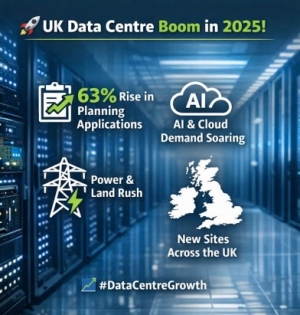
Planning activity for new data centres in England and Wales hit a record high in 2025, with applications rising 63 percent compared with 2024. That spike reflects intensifying demand for computing capacity driven by cloud services and artificial intelligence (AI) workloads.
According to analysis cited by Data Centre Review, more than 60 new planning applications for data centres were lodged in local planning systems last year. The figure excludes extensions to existing facilities and mixed-use developments that include data centre components, meaning the actual volume of data-related proposals moving through planning could be even higher.
What’s Driving the Surge
Several factors are fuelling this acceleration in planning demand:
- AI and cloud compute growth: Major technology companies are investing heavily in infrastructure to support AI, machine learning and cloud services. Hyperscale providers such as Google, Microsoft and OpenAI are expanding their global footprints, and the UK has emerged as a key strategic market.
- Competition for land and power assets: Developers are increasingly targeting non-traditional sites, from former hotels and industrial land to brownfield locations that offer proximity to power and connectivity.
- Geographic spread: While London and the South East remain hotspots, applications have broadened into the Midlands, North West, Yorkshire and Wales, driven by land, cost and grid considerations.
Beyond the Numbers
This planning surge takes place amid wider industry dynamics:
- The UK data centre market has been designated a Critical National Infrastructure, with government support for new facilities and initiatives to streamline connections to power grids.
- Despite strong interest, power availability and grid constraints are emerging as a key bottleneck for developers, prompting innovation in energy solutions and planning approaches.
- The broader global outlook remains one of rapid expansion, with industry forecasts predicting continued capacity growth through to 2030 as AI and cloud demand escalates.
What This Means for the UK Industry
The record-setting planning figures highlight several important trends:
- Growing confidence in digital infrastructure investment. Investors and developers are clearly bullish on future demand, submitting ambitious proposals even in competitive planning environments.
- Increased pressure on planning systems. Local authorities may face rising workloads and challenges in balancing development interests with community and environmental concerns.
- A shift in where data centres are being proposed. With costs and capacity constraints rising in traditional hubs, new regions are coming into focus for developers looking to secure sites with available power and space.
- Policy and infrastructure will matter more than ever. Grid capacity, streamlined approvals and supportive local policy will be crucial to turn planning applications into operational facilities.
The UK’s data-centre boom is accelerating at a pace few people outside the industry truly appreciate.
Driven by artificial intelligence, cloud computing, fintech, streaming, defence, and hyperscale platforms, Britain is now Europe’s largest data-centre market by several measures. From west London to Hertfordshire, Manchester, and Scotland, industrial estates, farmland and brownfield sites are being rapidly converted into secure, power-hungry digital infrastructure.
That growth is economically powerful. But it is also changing how energy, land and planning work in the UK.
For clients, contractors and investors in our sector, understanding what is happening behind the headlines matters.
Data centres now rival entire cities for power
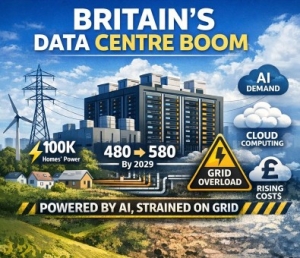
A single hyperscale data centre can consume as much electricity as 100,000 homes. The UK currently has around 480 data centres, and that number is forecast to exceed 580 within five years.
More importantly, their share of national electricity demand is rising fast:
Year Share of UK electricity
2024 2.5%
2030 (forecast) 10%
That is not just an IT story. It is a national infrastructure shift.
Electricity networks, substations, transmission lines and grid connections were not designed for dozens of multi-hundred-megawatt industrial users suddenly plugging into the system in the same postcodes.
This is now one of the biggest bottlenecks facing UK data-centre development.
Why grid capacity is becoming the new planning constraint
In west London and parts of the Southeast, new data-centre projects are already being delayed because the grid physically cannot supply any more power without major upgrades.
The same problem is beginning to affect housing, commercial property and industrial development. Where data centres cluster, they absorb large amounts of available capacity, forcing other projects to wait years for a connection.
From a construction and engineering perspective, this is now creating a second boom alongside data-centre build:
- New substations
- High-voltage cabling
- Grid reinforcements
- Power-routing infrastructure
- Backup generation and battery storage
This is becoming a multi-billion-pound industry in its own right.
Who ultimately pays for those upgrades?
Here is where the issue becomes sensitive.
In the UK, most transmission and distribution upgrades are funded through network charges. These are embedded in every electricity bill.
That means:
When the grid is reinforced to support data centres, the cost is typically spread across all users, not just the data centres themselves.
Households, SMEs and local businesses therefore share in paying for infrastructure built to serve energy-intensive digital industries.
This is not unique to data centres. It is how the UK energy system has always worked. But the scale and speed of AI-driven demand is unprecedented.
Why the Government is actively encouraging this growth
The UK government has classified data centres as critical national infrastructure. This gives them faster planning approval and makes them strategically protected.
At the same time, the Government is creating AI Growth Zones in areas with surplus renewable energy, particularly in Scotland, where wind generation is sometimes curtailed because the grid cannot move power south quickly enough.
The strategy is simple:
- Put data centres close to where power is abundant
- Reduce waste from unused renewable generation
- Avoid overloading the Southeast
Long-term, this should lower system costs. Short-term, it requires enormous investment in transmission networks.
What this means for the industry
For companies like Bauhaus and the engineers we support, this trend is structurally positive.
Data centres are no longer niche projects. They sit at the intersection of:
- AI
- Defence
- Finance
- Cloud
- Cybersecurity
- National resilience
- Energy infrastructure
That means sustained long-term demand for:
- Structured cabling
- Fibre networks
- OTDR and testing engineers
- Power and containment specialists
- Build, fit-out and maintenance labour
The UK is not building these sites for fashion or hype. They are being built because the digital economy depends on them.
The reality behind the headlines
Local resistance, particularly in green-belt areas, is understandable. Nobody likes seeing open land replaced by industrial buildings.
At the same time, modern data centres are not warehouses. They are:
- Highly secure
- Often powered by 100 percent renewable electricity
- Designed for heat-recovery and district heating
- Required to deliver biodiversity net gains
- Built to strict environmental standards
The bigger issue is not whether data centres should exist.
It is how Britain upgrades its grid fast enough to support them without unfairly pushing costs onto households.
That challenge is now firmly on the national agenda.
Bottom line
Data centres are becoming as essential to Britain’s economy as railways, ports and motorways.
They will change how land is used, how electricity flows and where investment goes.
For the digital infrastructure sector, that means opportunity.
For the energy system, it means transformation.
And for everyone, it means the UK is entering a new phase of being a truly AI-powered economy.