
Pizza Hut entering administration is another reminder of how tough things have become in hospitality. Once famous for its family buffets and all-you-can-eat deals, it’s another well-known name struggling to survive as costs keep climbing and customers watch their spending.
With business rates rising, food and staffing costs soaring, and people leaning towards cheaper, more casual options, many restaurants are being squeezed from every angle. It’s not that people have stopped eating out or ordering in, but they’re choosing value over experience. A quick pizza at home or a cheaper high-street meal often wins out over a sit-down restaurant visit.
From a data cabling and infrastructure point of view, the knock-on effect is clear. Fewer refurbishments, fewer new openings, and tighter budgets all mean less investment in structured cabling, Wi-Fi systems, and digital upgrades. Projects that might once have been planned alongside a rebrand or new layout are now being delayed or quietly dropped.
Interestingly, the retail sector, while facing many of the same cost pressures, is still pushing ahead with major technology investments. Stores are upgrading networks to support RFID systems, in-store analytics, and self-checkout solutions. These rollouts rely heavily on strong cabling and connectivity, and they’ve kept demand high for technical infrastructure work.
While hospitality seems to be slowing down, retail continues to invest, using technology to streamline operations, gather data, and stay relevant in an online-heavy world.
#Hospitality #Retail #DataCabling #Connectivity #Infrastructure
The Lost Art of Labelling
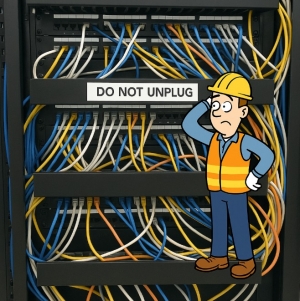
There’s something deeply satisfying about a perfectly labelled patch panel.
Every port in its place, every cable behaving, every label crisp, clear, and actually matching the documentation. It’s… beautiful.
But sadly, this level of order is becoming a dying art.
Too often, you open a comms cabinet and find chaos: cables criss-crossing like spaghetti, faded labels written in biro, and mystery connections that no one dares to touch. Somewhere, there’s always one port marked simply as “DO NOT UNPLUG”, the physical embodiment of fear.
Let’s be honest: proper labelling isn’t glamorous. It doesn’t get the applause that a perfect fibre run or a shiny new containment system does. But it’s the quiet hero of the data cabling world, the thing that separates a professional installation from a horror story.
Because when something goes down at 2 a.m., and you’re standing there with a head torch, sweating, trying to find Port 36A-03, that tiny white label suddenly becomes the most beautiful thing you’ve ever seen.
So, here’s to the data cabling engineers who label as they go.
The ones who align every tag, update every spreadsheet, and take pride in a cabinet that looks more like artwork than infrastructure.
This should be the standard, but sometimes it isn’t always the case.
You’re the unsung poets of patch panels.
And the world runs smoother because of you.